
Plastic folding boxes are crucial tools in the realm of modern logistics and warehousing, widely favored for their flexibility, portability, and space-saving qualities. Among various materials, polypropylene (PP) and polyethylene (PE) are the two most common choices, and food-grade materials further enhance their application value.
Polypropylene (PP) is a thermoplastic with excellent performance, featuring high heat resistance and good rigidity. Folding boxes made of PP can remain stable in higher temperature environments, are resistant to deformation, and are suitable for repeated use and stacking storage. With a smooth surface and easy-to-clean nature, they perform reliably in warehousing and transportation, and are widely used for packaging turnover in industrial parts, electronic products, and other fields. In addition, PP material also possesses a certain degree of impact resistance, maintaining a longer service life during frequent folding and unfolding processes.
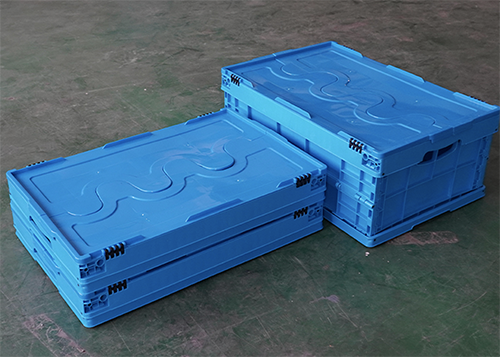
Polyethylene (PE) is renowned for its excellent flexibility and impact resistance. Folding boxes made of PE material are typically lighter and have excellent low-temperature resistance, making them less prone to cracking even in cold conditions. This characteristic makes them particularly suitable for cold chain logistics or outdoor use scenarios. The molecular structure of PE is relatively tight, providing good resistance to most chemicals, making it commonly used in agriculture, fisheries, and general cargo transportation.
Food-grade materials refer to plastic materials that meet national food safety standards. Generally, both PP and PE can achieve food-grade requirements through rigorous certification. These materials do not contain harmful substances, will not contaminate the food they come into contact with, are safe and non-toxic, and have good oil and water resistance. Food-grade plastic folding boxes are commonly used in scenarios such as fruit and vegetable distribution, catering supply chains, and supermarket warehousing. They not only ensure hygiene and safety but are also easy to clean and disinfect, meeting the hygiene management standards of the modern food industry.
The choice of material for folding boxes depends on actual needs. If high temperature resistance and strong rigidity are required, PP is more suitable; if flexibility and low temperature resistance are prioritized, PE is the preferred option. When it comes to food-related applications, it is essential to confirm that the material has food-grade certification to ensure health and compliance. With technological advancements, some new composite materials are continuously emerging, but PP and PE, with their balanced performance and mature processes, remain the mainstream material choices for plastic folding boxes.
In summary, understanding the characteristics of PP, PE, and food-grade materials can assist users in more precisely selecting suitable folding boxes, thereby enhancing efficiency, ensuring safety, and unlocking greater value in logistics management and daily use.