
The plastic pallets that are popular in China have relatively standard sizes, but the specific choice needs to be made based on your usage scenario and the characteristics of your goods. Here are the main size specifications and selection suggestions:
Mainstream standard size (commonly used in China)
In China, there are primarily two mainstream standardized sizes that are widely adopted and comply with national standards:
· 1200mm × 1000mm · Features: Internationally recognized, and also the preferred size recommended in Chinese national standards, with the best compatibility with most racks and transport vehicles.
· Application Scenario: It is widely used in various domestic general warehousing, transportation, and logistics processes, and is one of the most commonly used specifications.
· 1100mm × 1100mm · Features: Square size, primarily used in Asian markets such as Japan and Korea, with a popularity in domestic applications second only to 1200×1000mm.
Application Scenario: It is particularly suitable for goods exported to Japan and South Korea, and is also commonly used in domestic food, chemical, and other industries.
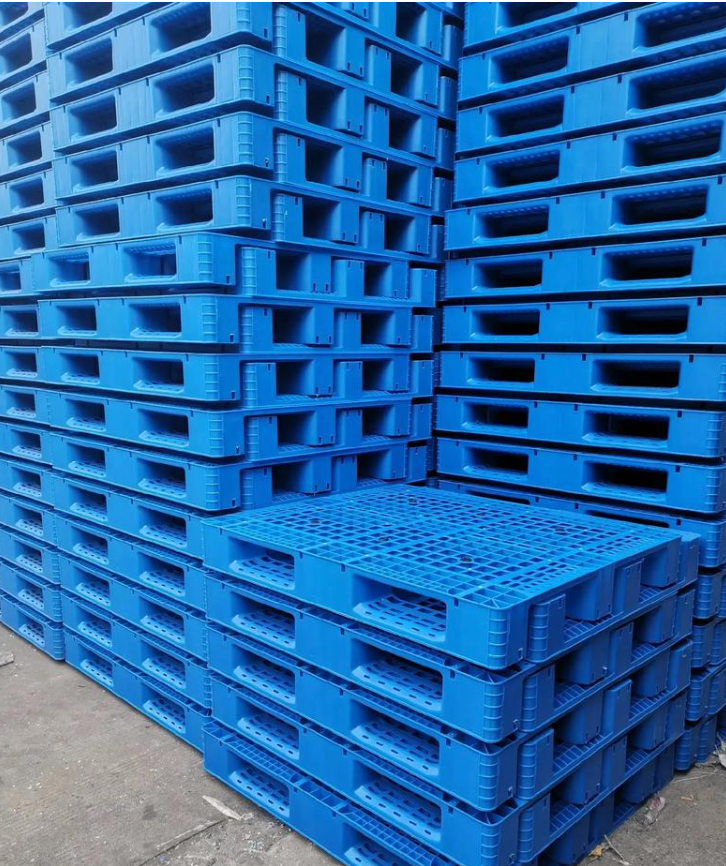
Classified by size and purpose
In addition to the aforementioned two standard sizes, there is a wide range of sizes available on the market, which can be classified and referenced as follows:
· Small pallets · Common size examples: 600×400mm, 500×300mm, etc. (length < 1m, width < 0.6m).
· Applicable scenarios: Suitable for the handling and storage of small and lightweight goods, or as a base plate on shelves.
· Medium-sized pallet · Common size examples: 1200×800mm, 1100×700mm, etc. (approximately 1 meter in length and 0.6 meters in width).
· Applicable Scenario: This is the most common type, suitable for stacking and transporting the vast majority of standard cartons and boxed goods. Specifically, 1200×800mm is often referred to as the “European Standard Pallet”, a commonly used specification for exports to Europe.
· Large/heavy-duty pallets · Common size examples: 1400×1200mm, 1500×1200mm, 1200×1200mm, etc. (Both length and width are relatively large).
· Applicable scenarios: Applicable to bulky or particularly heavy goods, such as large machinery and equipment parts, building materials, industrial raw materials, etc.
How to choose the right pallet size for you?
Choosing a size involves not only considering length and width, but also taking into account the following points:
- Matching transportation vehicles and shelves: This is the primary principle. Confirm the internal dimensions of the truck body, container size (especially for export), as well as the width and depth of each shelf layer in the warehouse, to ensure that the pallets can be smoothly placed with operating space reserved.
- Adaptation of cargo packaging: The ideal pallet size should fully utilize the pallet surface area to stack goods, reduce overhang, and ensure stable stacking. For example, the size of standard cartons is often an integer fraction of the pallet size.
- Consider the usage scenario: If it is for export, it is essential to understand the pallet standards required by the destination country or customer in advance (such as the commonly used 1200×800mm in Europe and 48×40 inches, approximately 1219×1016mm, in North America). If it is used in automated three-dimensional warehouses or with standard logistics turnover baskets, it must adopt a specific size that matches them.
- Pay attention to load-bearing capacity: Larger size does not directly equate to higher load-bearing capacity. Load-bearing capacity mainly depends on the structural design (such as Chuan-shaped, Tian-shaped, or nine-foot type) and material (new material vs recycled material) of the pallet. It is essential to select a pallet with the appropriate load-bearing level based on the total weight of the goods (static load) and the dynamic impact force during forklift handling (dynamic load).
Besides size, the structure of the pallet (such as single/double-sided, grid/flat), material (new material is more durable), and whether it complies with national (GB/T) or international standards are also key factors that affect the usage effect and cost.