
Plastic pallets, as an indispensable basic tool in modern logistics warehousing, often confuse buyers with their diverse size options. Which size is most widely used in the market? What kind of industry demand does this reflect? Today, let’s delve into this topic.
Based on feedback data from major logistics hubs, manufacturing parks, and third-party warehouses across the country, the plastic pallet with a size of 1200mm×1000mm is undoubtedly the undisputed “king” in the current market, occupying the largest market share. The popularity of this size is by no means accidental, but rather a result of its profound alignment with multiple domestic and international standards and actual operational scenarios.
Firstly, in terms of standard compatibility, the 1200mm×1000mm pallet is a standard European pallet size. It perfectly matches the internal width of most international standard containers (such as 40-foot high containers and 45-foot high containers), maximizing the use of container space, reducing gaps and shaking during cargo transportation, and ensuring transportation safety and efficiency. At the same time, it is also compatible with the standardized logistics modules advocated by many industries in China.
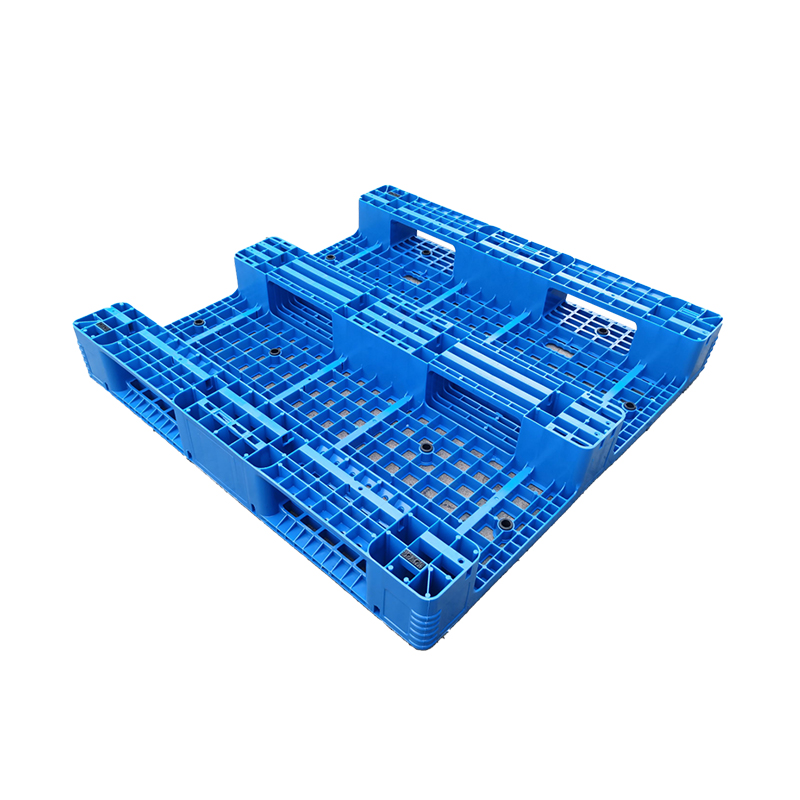
Secondly, this size is highly compatible with common shelf systems and handling equipment. Whether it is traditional beam-type shelves or modern automated storage and retrieval systems (AS/RS), the design of their storage locations generally gives priority to this size. Coupled with standard forklifts, ground bulls, and other handling tools, efficient and smooth inbound and outbound operations can be achieved, reducing equipment adaptation costs.
Crucially, the 1200mm×1000mm pallet excels in terms of adaptability for cargo stacking. It is highly suitable for carrying unitized cargo composed of standard cartons or material boxes. For instance, the packaging dimensions of many consumer goods, electronic products, and industrial components are designed based on modular sizes such as 600mm×400mm. These items can be neatly stacked on this size pallet, forming stable and orderly cargo units, thereby significantly enhancing warehouse space utilization and loading/unloading efficiency.
Of course, there are other commonly used sizes in the market. For example, 1100mm×1100mm (Japanese and Korean standards) is widely used in specific industries and foreign-funded enterprises, while 1200mm×800mm (partially European standards) also holds a position. The final choice needs to be comprehensively determined based on your cargo packaging specifications, transportation tools (such as the inner diameter of the carriage), storage shelf parameters, and the requirements of upstream and downstream supply chains.
In summary, choosing the size of plastic pallets is essentially selecting an interface that efficiently interfaces with the entire logistics system. The reason why 1200mm×1000mm has become mainstream is precisely because it provides the widest compatibility and the highest operational efficiency. In modern supply chains that pursue standardization, cost reduction, and efficiency improvement, choosing mainstream sizes often means lower overall costs, smoother process connections, and stronger supply chain resilience. Before making purchasing decisions, it is advisable to examine your own logistics links. The mainstream size may be your optimal starting point.